I don't get to see much of Southpark - but oh my effing lawwwd - this is some funny shit.
Tuesday, January 23, 2007
Saturday, January 6, 2007
Peanuts

They're cute right? So this is for the trivia whores like me.
Peanuts is the brainchild of Charles M. Schulz (the M's for Monroe, since this is trivia), first published in October 2, 1950 and it ran upto February 13, 2000 - the day after Schulz's death.
This is the first ever Peanuts strip -

click to enlarge
And this is the last one -

click to enlarge
The main characters are -
 Charlie Brown - Charlie Brown wins your heart with his losing ways. It always rains on his parade, his baseball game, and his life. He's an inveterate worrier who frets over trifles (but who's to say they're trifles?). Although he is concerned with the true meaning of life, his friends sometimes call him "blockhead." Other than his knack for putting himself down, there are few sharp edges of wit in his repertoire; usually he's the butt of the joke, not the joker. He can be spotted a mile away in his sweater with the zig zag trim, head down, hands in pocket, headed for Lucy's psychiatric booth. He is considerate, friendly and polite and we love him knowing that he'll never win a baseball game or the heart of the little red-haired girl, kick the football Lucy is holding or fly a kite successfully. His friends call him "wishy-washy," but his spirit will never give up in his quest to triumph over adversity.
 Snoopy - Snoopy is an extroverted beagle with a Walter Mitty complex. He is a virtuoso at every endeavor- at least in his daydreams atop his doghouse. He regards his master, Charlie Brown, as "that round-headed kid" who brings him his supper dish. He is fearless though prudently cautious about "the cat next door." He never speaks- that would be one human trait too many- but he manages to convey everything necessary in facial expressions and thought balloons. A one-man show with superior intelligence and vivid imagination, he has created such multiple personalities as: Joe Cool, World War I Flying Ace, Literary Ace, Flashbeagle, Vulture, Foreign Legionnaire, etc.
Woodstock - Woodstock is the smallest of the Peanuts characters but has a big presence for a little bird. He's a little inept, his flying and logic are erratic, but he can type and take shorthand and usually is game for anything Snoopy wants to do. Although he's the butt of many of Snoopy's practical jokes, he's the beagle's closest friend and confidant- and has made attempts at retaliation. Because of his size and the company he keeps, Woodstock is an accident waiting to happen. Being a bird and tiny, he gets a little insecure around Thanksgiving and big moving objects. He's the only baseball player who gets an automatic walk if the ball rolls over him. Woodstock talks birdspeak only, and finds an alphabet made up entirely of exclamation points quite adequate to express such emotions as distress, frustration and a real temper. His flocking friends are Bill, Harriet, Olivier and Conrad.
 Lucy - Lucy Van Pelt works hard at being bossy, crabby and selfish. She is loud and yells a lot. Her smiles and motives are rarely pure. She's a know-it-all who dispenses advice whether you want it or not--and for Charlie Brown, there's a charge. She's a fussbudget, in the true sense of the word. She's a real grouch, with only one or two soft spots, and both of them may be Schroeder, who prefers Beethoven. As she sees it, hers is the only way. The absence of logic in her arguments holds a kind of shining lunacy. When it comes to compliments, Lucy only likes receiving them. If she's paying one--or even smiling--she's probably up to something devious.
 Linus - Linus Van Pelt inspired the term "security blanket" with his classic pose. He is the intellectual of the gang, and flabbergasts his friends with his philosophical revelations and solutions to problems. He suffers abuse from his big sister, Lucy, and the unwanted attentions of Charlie Brown's little sister, Sally. He is a paradox: despite his age, he can put life into perspective while sucking his thumb. He knows the true meaning of Christmas while continuing to believe in the Great Pumpkin.
 Peppermint Patty - Peppermint Patty is a pro on the baseball diamond, but in the classroom she's a D-minus all the way. Bold, brash and tomboyish, what she lacks in common sense she makes up for in sincerity. She's the only one who calls Charlie Brown "Chuck." Oblivious to much that goes on around her, for a long time she seemed unaware that "the funny-looking kid who plays shortstop" was a beagle. She has trouble staying awake in class; most of her waking hours in the schoolroom are spent analyzing the probability patterns of true-false tests.
 Marcie - Marcie is Peppermint Patty's best friend. From the moment they met at summer camp, Marcie has called Peppermint Patty "Sir" out of admiration and misguided manners. An unlikely pair, they seem to have nothing in common yet that is what makes their friendship so genuine. Marcie is the smartest of the Peanuts gang, but also the most naive. She's always willing to help out her friend with school work and she's not above sharing test answers or calling her on the phone to remind her of homework assignments. There is an innocence to Marcie and Peppermint Patty is her protector. Marcie is also completely inept when it comes to sports, yet they still let her play on the baseball team. If Marcie and Peppermint Patty ever have a falling out it's likely to be over Charlie Brown, who they both secretly love.
 Sally - Sally Brown's brother, Charlie Brown, was so pleased and proud when she was born that he passed out chocolate cigars. Since then he's been trying to understand her. She always looks for the easy way out, particularly at school, where her view of life reflects much of the frustration and confusion kids experience. Her speech is riddled with malapropisms. Uninhibited, and precocious, she has a schoolgirl crush on Linus, her "Sweet Babboo." She may never win Linus' heart, but she has her big brother wrapped around her little finger. Sally, writing letters or doing homework, causes pain and joy to her fans in roughly equal proportions.
 Schroeder - Schroeder, who idolizes Beethoven, brought classical music to the Peanuts strip. Reserved and usually unruffled, Schroeder reacts only when Woodstock tries to make his grand piano into a playground, or Lucy seeks to make it her courting grounds. The latter can lead to minor violence.
 Pigpen - Before grunge was cool, Pigpen made his debut in the Peanuts comic strip on July 13, 1954 and since then has been the butt of "dirt" gags. He walks around in a cloud of dust, sprinkling dirt on all he comes in contact with. Pigpen is happily messy. He doesn't try to explain it, hide it, fight it. For him, it's just a fact of life. His slovenly ways paid off in 1993 with a series of television commercials for Regina vacuum cleaners which combined animation with live-action.
Franklin - Franklin met Charlie Brown at the beach in 1968. They'd never met before because they went to different schools, but they had fun playing ball so Charlie Brown invited Franklin to visit him at this house across town for another play session. Later, Franklin turned up as center-fielder on Peppermint Patty's baseball team and sits in front of her at school. Franklin is thoughtful and can quote the Old Testament as effectively as Linus. In contrast with the other characters, Franklin has the fewest anxieties and obsessions. He and Charlie Brown spend quite a bit of time talking about their respective grandfathers. When Franklin first appeared in the late 60s, his noticeably darker skin set some readers in search of a political meaning. However, the remarkable becomes unremarkable when readers learn that Schulz simply introduced Franklin as another character, not a political statement.
 Rerun - Rerun Van Pelt is often mistaken for Linus even though he's his little brother. He can always be recognized in his trademark overalls. Rerun is more skeptical than his brother, much harder to convince, and always gets around Lucy where Linus gives in. His only fear is being the passenger on one of his mother's bicycle-riding errands. Somehow, Rerun is the only witness to her riding into grates and potholes. Luckily, he always wears a helmet. Rerun also longs for a dog of his own, but since his parent won't let him have one, he tries to "borrow" Snoopy from Charlie Brown. Snoopy won't have any part of it unless Rerun brings cookies.
For more stuff - click here and here.
Thursday, December 21, 2006
City

I love my city - with its unassuming, languid, dust-layered beauty, smiling at you in gentle sunlight during winter mornings and evenings. Freeskool Street, decked up for Christmas – jazz and carols blasting through the gramophones, the jingle of the tana rickshaws mingling with the smell of telebhajas, kati rolls and old second-hand books from every nook and cranny – tantalizing, mouth watering. Dhormotolaye dhormoshonkot. Shirt kholo. Oborodh koro - half naked bodies fluttering flags against the half-restored LIC building. Ahh, ki dramabaji! Ki entertainment! My pretty, crazy city. New Market jomjomat, with fake Christmas trees and scary Santa Clauses on the sidewalks and bright paper stars and tinsel adorning the skies. Lazy tram ride – maidan’s green beauty, juxtaposed against a smog-lined winter sky, officers on their horses, Shahid Minar, tall, ponderous, poetic, against the evening sun. The crows fly home. The sun sets. The evening chill draws out the mufflers and monkey-tupis, the smell of naphthalene stubbornly hanging on to its wooly fabric. Steaming cha, muri-makha and querulous adda.

For better or for worse, I love this city.


See also : Nearsight's city lights post taken with the Fujifilm Finepix S9500. Heck, see his entire blog.
Thursday, December 14, 2006
Henri de Toulouse Lautrec
Henri de Toulouse Lautrec (Novermber 24, 1864 - September 9, 1901) was a French painter, printmaker, draftsman, and illustrator, whose immersion in the decadent and theatrical life of fin de siecle yielded an oeuvre of provocative images of modern life. (see wiki)

At the Moulin Rouge

The Kiss
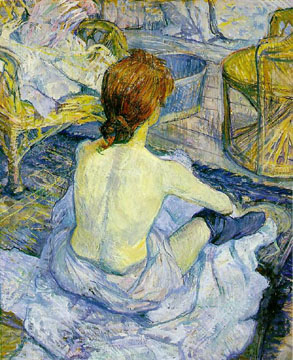
The Toilette

Van Gogh's portrait


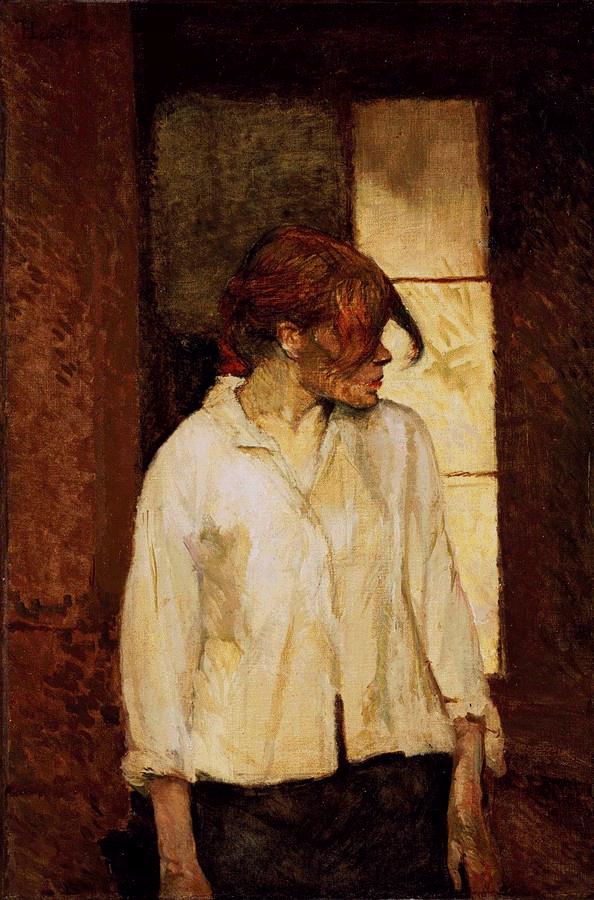
Rosa La Rouge - À Montrouge
The Moulin Rouge series - et autres

Best known for his paintings of the Moulin Rouge and the hedonistic Parisian city life, Lautrec was one of the most exciting painters of his era. His contemporaries were Degas, Van Gogh, Renoir, Cezanne, Gaugin and Seurat. I've selected a motley set of his paintings, not in any order of their creation or phase or anything like that. Just stuff I like. To see more of his paintings and posters, click here and here.
Tuesday, December 5, 2006
Street Art

Los Angeles, originally uploaded by it is what it is....
For more, check Wooster. The coolest blog I've ever come across.
Friday, December 1, 2006
Wind
This house has been far out at sea all night,
The woods crashing through darkness, the booming hills,
Winds stampeding the fields under the window
Floundering black astride and blinding wet
Till day rose; then under an orange sky
The hills had new places, and wind wielded
Blade-light, luminous black and emerald,
Flexing like the lens of a mad eye.
At noon I scaled along the house-side as far as
The coal-house door. Once I looked up -
Through the brunt wind that dented the balls of my eyes
The tent of the hills drummed and strained its guyrope,
The fields quivering, the skyline a grimace,
At any second to bang and vanish with a flap;
The wind flung a magpie away and a black-
Back gull bent like an iron bar slowly. The house
Rang like some fine green goblet in the note
That any second would shatter it. Now deep
In chairs, in front of the great fire, we grip
Our hearts and cannot entertain book, thought,
Or each other.We watch the fire blazing,
And feel the roots of the house move, but sit on,
Seeing the window tremble to come in,
Hearing the stones cry out under the horizons.
Ted Hughes
This poem was meant to decribe the storminess of Hughes' and Plath's relationship and the growing distance in it. Being a sucker for romance and unrequitted love and what-not - the Hughes-Plath relationship has always fascinated me. And I recently discovered this poem - it's so graphic, so blunt and sad - I love it.
The woods crashing through darkness, the booming hills,
Winds stampeding the fields under the window
Floundering black astride and blinding wet
Till day rose; then under an orange sky
The hills had new places, and wind wielded
Blade-light, luminous black and emerald,
Flexing like the lens of a mad eye.
At noon I scaled along the house-side as far as
The coal-house door. Once I looked up -
Through the brunt wind that dented the balls of my eyes
The tent of the hills drummed and strained its guyrope,
The fields quivering, the skyline a grimace,
At any second to bang and vanish with a flap;
The wind flung a magpie away and a black-
Back gull bent like an iron bar slowly. The house
Rang like some fine green goblet in the note
That any second would shatter it. Now deep
In chairs, in front of the great fire, we grip
Our hearts and cannot entertain book, thought,
Or each other.We watch the fire blazing,
And feel the roots of the house move, but sit on,
Seeing the window tremble to come in,
Hearing the stones cry out under the horizons.
Ted Hughes
This poem was meant to decribe the storminess of Hughes' and Plath's relationship and the growing distance in it. Being a sucker for romance and unrequitted love and what-not - the Hughes-Plath relationship has always fascinated me. And I recently discovered this poem - it's so graphic, so blunt and sad - I love it.
Thursday, November 30, 2006
paranoid android
One of my favourite Radiohead tracks - weirdass video. You'll need a good connection though, to view it properly. Happy viewing!
Sunday, November 26, 2006
Jazz
 "I'm crazy about this City.
Daylight slants like a razor cutting the buildings in half. In the top half I see looking faces and it's not easy to tell which are people, which the work of stonemasons. Below is shadow where any blasé thing takes place: clarinets and lovemaking, fists and the voices of sorrowful women. A city like this one makes me dream tall and feel in on things. Hep. It's the bright steel rocking above the shade below that does it. When I look over strips of green grass lining the river, at church steeples and into the cream-and-copper halls of apartment buildings, I'm strong. Alone, yes, but top-notch and indestructible--like the City in 1926 when all the wars are over and there will never be another one. The people down there in the shadow are happy about that. At last, at last, everything's ahead. The smart ones say so and people listening to them and reading what they write down agree: Here comes the new. Look out. There goes the sad stuff. The bad stuff. The things-nobody-could-help stuff. The way everybody was then and there. Forget that. History is over, you all, and everything's ahead at last..."
From Toni Morrison's Jazz


Welcome
Say hello to Carnival, my new blog. I'll be putting up pictures, poems, stories, songs, videos, art work - whatever I like and hopefully you'll like it too.
Subscribe to:
Posts (Atom)